To properly care for your hair, it’s important to understand what it’s made of and how it works. When you understand what your hair is made of, you can better identify what it needs. In this way, the more effective your hair care routine will be.

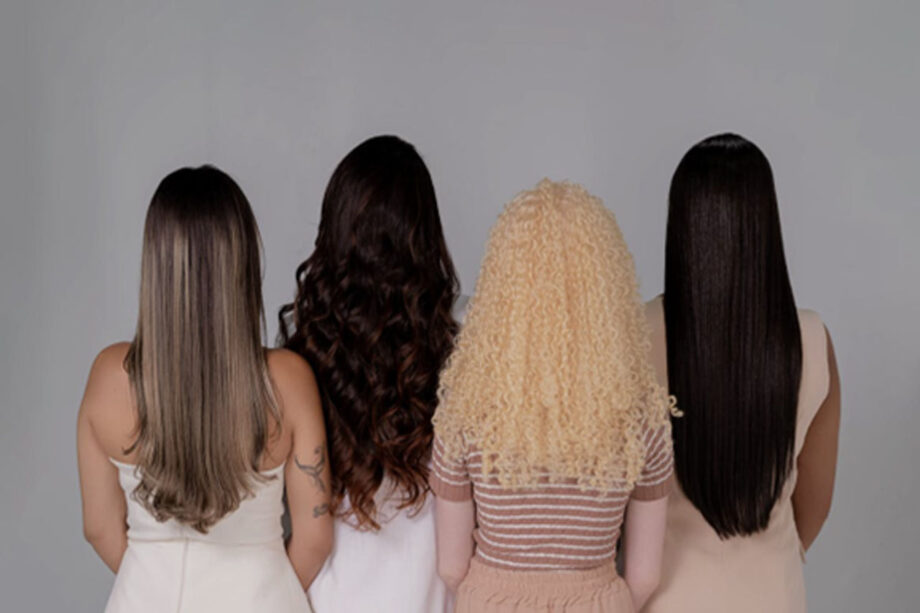
The next time you wash your hair, allow it to air-dry without any products in it. This will help you to define the natural shape or pattern of your strands. Then look:
- If your hair dries straight without a bend or curl, then you have straight hair (hair type 1).
- If your hair dries with a slight curve or “S” shape, then you have wavy hair (hair type 2).
- If your hair dries with a defined curl, then you have curly hair (hair type 3).
- If your hair dries to form tight curls or spirals, then you have coily hair (hair type 4).
To find out your hair texture, which is about how thick each individual strand is, do a quick test. Take one strand of hair and roll it between your fingers:
- If you have fine hair, then you can barely feel it.
- If you have medium hair, then you feel it slightly.
- If you have coarse hair, your hair feels thick and strong.
Or instead, compare your hair to a sewing thread. If your hair feels thinner than the thread then you have fine hair, if it’s the same as the thread then it’s medium, and if it’s thicker then it’s coarse.

For your hair porosity, which is how your hair absorbs moisture, take just a glass of water and a string of your hair. Drop your hair in the water and watch if it floats or sinks.
- If your hair floats on top, it has low porosity (resists moisture).
- If your hair sinks slowly, it has medium porosity (balanced).
- If your hair sinks quickly, it has high porosity (absorbs fast but loses moisture fast).
However, this test isn’t always 100% accurate, so combine it with how your hair behaves. So, for example:
Low porosity hair
- Water sits on your hair
- Takes long to dry
- Products build up easily
Medium porosity hair
- Holds styles well
- Doesn’t feel too dry or too greasy
High porosity hair
- Dries very fast
- Gets frizzy easily
- Absorbs products quickly but doesn’t stay hydrated
To better understand your hair type’s needs, it’s useful to go a step further and identify your hair subtype using the A-B-C classification system. Each main type (1 to 4) is further divided based on the thickness of the strand and the tightness or looseness of the wave, curl, or coil.
Type 1: Straight Hair
Straight hair reflects most light, giving it a naturally glossy appearance. It tends to be more resistant to styling but is often lower in frizz.
- 1A: Very fine, soft, and completely straight
Avoid heavy products that can weigh hair down. Use lightweight volumizing shampoos and dry shampoos to add lift. This type of hair is slippery, with thin strands that don’t hold curls easily. It also gets oily quickly.
- 1B: Straight with a bit more body and slight volume
A light mousse or sea salt spray can help build texture. Volumizing conditioners are ideal. This hair type is thicker than 1A, with more structure and movement. It can hold styles slightly better.
- 1C: Straight but coarse and thick, with a hint of wave
Smoothing serums or light oils help control frizz. Regular hydration is key to manage texture. This type is resistant to curling or shaping but can become frizzy. May show a slight wave in humid weather.
Type 2: Wavy Hair
This type lies somewhere between straight and curly, offering a versatile texture that can lean toward smooth or voluminous depending on styling.
- 2A: Fine and loose “S” shaped waves
Avoid heavy styling products. A light curl enhancer or leave-in conditioner will boost definition. This hair type is flat at the roots with soft waves that begin at mid-length. Easily straightened or curled.
- 2B: More defined waves with some frizz
Use anti-frizz sprays or smoothing serums. Diffusing while drying enhances natural texture. This type is medium-textured hair with more visible “S” patterns starting closer to the roots.
- 2C: Thick, coarse waves that verge on curly
Moisture-rich shampoos and deep conditioning masks help tame frizz. A curl cream helps define the wave. This hair type has dense, voluminous waves with potential for loose curls. Prone to frizz in humidity.
Type 3: Curly Hair
This hair type forms distinct, springy curls and tends to be drier due to its structure, which makes it harder for natural oils to travel down the hair shaft.
- 3A: Loose, well-defined spiral curls
Use curl-defining creams or light gels. Avoid sulphates and silicones to prevent buildup. It’s soft, shiny curls with large, well-formed spirals about the size of a small pen or your thumb.
- 3B: Springy ringlets from tight to corkscrew shape
Hydration is essential, opt for rich creams and conditioner-washing routines. Finger-coiling can enhance shape. These are tighter curls with more volume and less natural shine than 3A. Texture varies.
- 3C: Very tight curls with a lot of volume
Use ultra-moisturising leave-ins and protective styles. Avoid excessive brushing to maintain curl clumps. This type of hair is dense, highly textured curls about the width of a pencil. Lots of body and shrinkage (appears shorter than it actually is when dry).
Type 4: Coily Hair
Coily or kinky hair is the most delicate and tightly textured. It has a zig-zag pattern or tight coil and often experiences the most shrinkage.
- 4A: Soft coils with a defined “S” pattern
Emollient-rich products, like shea butter or avocado oil, help retain moisture. Stretch styles (like twist-outs) reduce tangling. These are defined coils that are springy and soft. Retains some moisture and curl definition.
- 4B: Z-shaped curls with less definition
Apply heavy creams and butters. Protective styles like braids or bantu knots help prevent breakage. This hair bends in sharp angles like the letter “Z,” with little natural curl definition. It’s very fragile.
- 4C: Very tight, densely packed coils with maximum shrinkage
Requires intensive moisture routines, minimal manipulation, and frequent deep conditioning. Detangle with fingers or wide-tooth combs. This is the most fragile hair type. Coils are almost invisible without manipulation. Shrinks up to 75% of actual length.
Once you find the routine that works for your hair type, you’ll start to notice real improvements in how your hair looks and feels over time. Be patient with the process, make small adjustments when needed, and focus on building habits that support healthy, manageable hair in the long run. We hope this little guide has helped you and if you have any thoughts or tips, share them down below!